Retail is an inventory risk business. 85-97% of every rupee a retailer earns goes toward acquiring, storing, moving, funding, and selling inventory. The remaining 3-15% is profit — the reward for getting the bet right. Autonomous Commerce is the framework for deciding, per workflow, the right level of autonomy.
Retail is an inventory risk business. 85-97% of every rupee a retailer earns goes toward acquiring, storing, moving, funding, and selling inventory. The remaining 3-15% is profit — the reward for getting the bet right. This is not a metaphor. It is the arithmetic of every annual report from Inditex to DMart to Reliance Retail. Revenue is selling inventory. COGS is buying inventory. Rent is storing inventory. Employees manage inventory. Everything else is a derivative.
Today, humans place this bet. They forecast demand, select suppliers, set prices, plan promotions, allocate stock, and decide markdowns. AI has entered the conversation — but in most organisations, it is still a surface-level addition. The spreadsheet is better-formatted. The PowerPoint is faster. The forecast has one more input. The bet itself has not changed.
Autonomous Commerce changes this. Not incrementally. Structurally. It is a framework for deciding, per workflow, the right level of autonomy — what should be fully autonomous, what should be AI-assisted, and what should remain human. The question is not “how do we use AI in retail?” The question is “at what level of autonomy should each workflow operate, and what must be true to move it to the next level?”
The approach covers both technology and organisation. On the technology side, the platform connects AI to every workflow and data stream — demand signals, inventory positions, supplier networks, pricing engines, and fulfilment nodes become a single addressable surface. The data catalog (Paper 2) documents the 67 activities, 120 SOPs, and 35 data sources that power these workflows. On the organisation side, each function must make a deliberate choice about its target autonomy level — and the people freed by that transition are redirected into AI-native roles that did not exist before.
The transition between autonomy levels is not a technology upgrade. It is a risk reduction proof.
Every retail workflow sits at some level of autonomy today. Moving it to the next level requires answering one question: does this move demonstrably reduce risk? Not “can AI do this?” — that is a technology question. Not “will this save headcount?” — that is an efficiency question. The question is whether giving the machine more authority over this workflow produces measurably better outcomes with measurably lower risk. If you cannot prove it, you are not ready. If you can prove it but the organisation will not act on the proof, the problem is not technology. It is governance.
Risk manifests differently across the value chain. Four domains, four categories of risk, one standard: here is the data, here is the A/B test, here is the measurable outcome in rupees. This rule governs everything that follows.
The risk of building or holding stock the customer will not buy at full price.
The risk of paying the wrong price, picking the wrong supplier, or committing capital too early.
The risk of stock reaching the wrong store at the wrong time, or not at all.
The risk of leaving margin on the table — under-pricing, over-discounting, missing the moment.
Six levels of autonomy, adapted from the Autonomous Networks taxonomy standardised by TM Forum for telecommunications. The domains change — from network fault management to demand forecasting, from radio access to supply chain — but the architecture of autonomy is universal. Each level defines who decides, who executes, and who bears risk.
Humans execute all tasks. Systems are record-keeping tools. Monitoring and data capture only. All risk borne by human judgement and experience.
Humans make all decisions. AI performs specific, repetitive subtasks on pre-configured rules — report generation, data formatting, alert triggering. Risk unchanged. Execution speed improved.
Humans own decisions but operate within AI-generated recommendations. Closed-loop execution for narrow, well-defined units. Risk reduced in narrow domains with proven rule sets.
Humans set policies and handle exceptions. The system senses real-time changes and self-optimises within defined boundaries — adjusting to demand shifts, competitive moves, and supply disruptions. Risk actively managed by the system within guardrails.
Humans set strategic intent and review outcomes. The system makes cross-domain decisions via predictive analysis and continuous learning. Coordinates across Plan, Buy, Move, and Sell simultaneously. Risk predicted and pre-empted.
Humans define purpose, values, and constraints. The system operates the full lifecycle via cognitive self-adaptation — self-healing, self-optimising, continuously learning. Risk is structurally minimised.
This is a design choice, not a failure of ambition. Workflows that are high-frequency, data-rich, and reversible — demand forecasting, pricing, replenishment, allocation — move toward L4-L5. Workflows that are low-frequency, judgement-intensive, and irreversible stay deliberately at lower levels. The right answer is not a uniform target. It is a portfolio of autonomy levels — chosen deliberately, per workflow, governed by provable risk reduction.
What categories to enter, what the brand stands for. AI-informed, human-decided.
AI-generated, human-curated.
Compliance and ethical judgements stay AI-monitored, human-accountable.
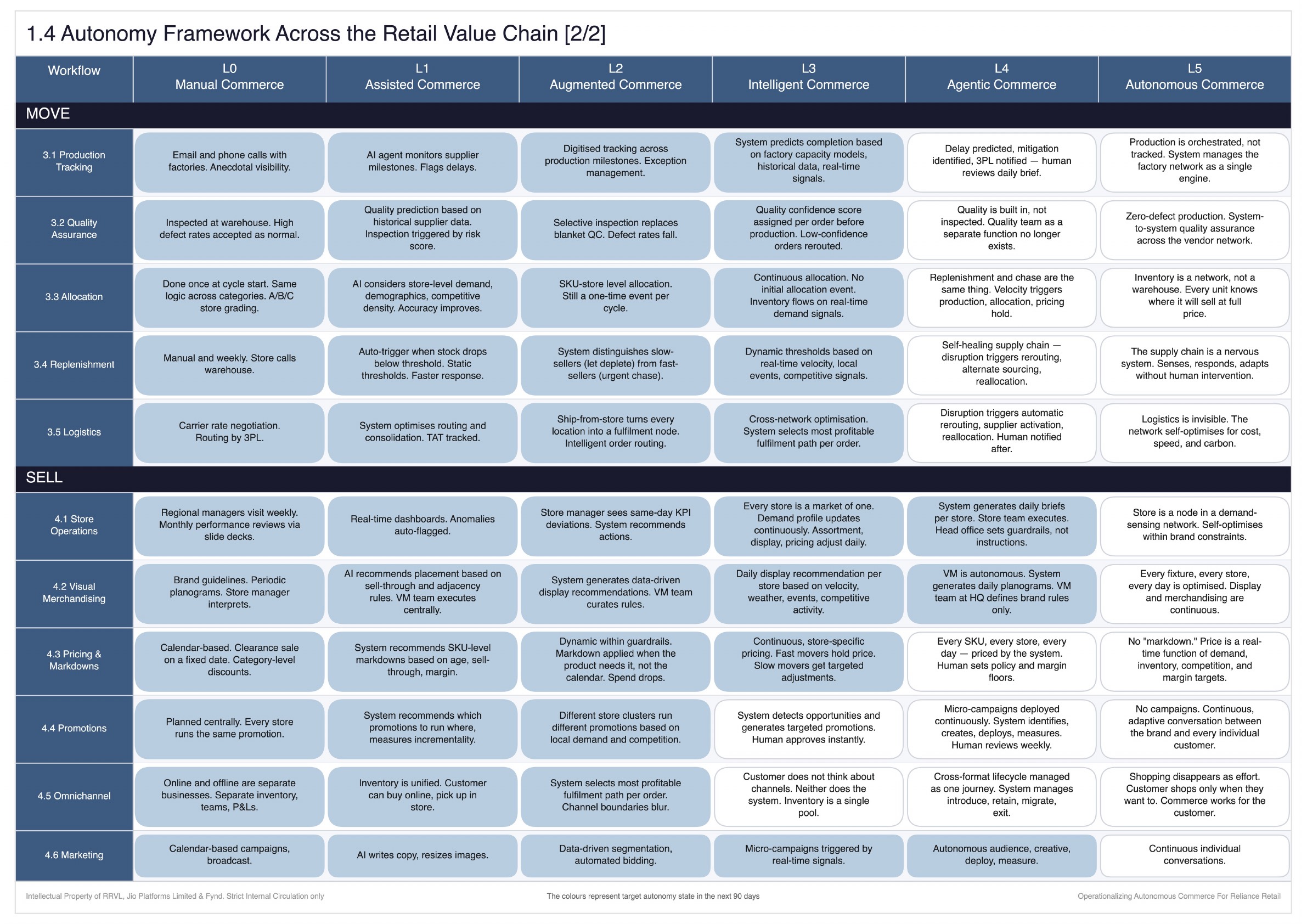
The matrix maps retail workflows against the six autonomy levels. Read it left to right to see how a single workflow evolves from fully manual to fully autonomous. Read it top to bottom within a value-chain stage to see the breadth of autonomy decisions an organisation must make simultaneously. The shaded cells show the target autonomy state in the next 90 days.
Across 21 core retail workflows, L2 (Augmented) is the baseline — every workflow reaches at least this level. Of these, 43% move to L3 (Intelligent) where the system optimises within guardrails and humans handle exceptions. 29% reach L4 (Agentic) where the system makes cross-domain decisions and humans set intent. The remaining 24% operate at L2 where AI recommends and humans decide.
Every cell describes what that workflow looks like at that level of autonomy. Verbatim from the paper. The shaded cells are L0–L3, the workflow's current state for most stages today; clear cells are L4–L5, the targets.
| # | Workflow | L0Manual | L1Assisted | L2Augmented | L3Intelligent | L4Agentic | L5Autonomous |
|---|---|---|---|---|---|---|---|
| Plan | |||||||
| 1.1 | Demand Forecasting | Spreadsheets and instinct | AI summarises trends | ML forecasts, human reviews | Continuous signal engine | Forecast triggers actions | Demand is sensed, not forecast |
| 1.2 | OTB Budgeting | Excel, quarterly cycle | AI formats the deck | AI proposes OTB based on sell-through, planner reviews | Auto-reallocating constraint | Cross-format OTB, human sets intent | Real-time financial envelope |
| 1.3 | Range Architecture | Hand-built option plans | AI generates trend reports | AI-generated options, buyer chooses | System generates full range plans | Human scans and asks “what if?” | Signal to order in days |
| 1.4 | Space Planning | Fixed planograms, regional clusters | AI suggests layouts | Weekly GMROF optimisation | Continuously optimised per store | Daily VM briefs per store | Every store is a market of one |
| 1.5 | Assortment Planning | Periodic, cluster-level | AI surfaces bestsellers | Store-cluster, AI recommends | Store-level, demand-driven | Cross-format cannibalisation detection | Unified demand sensing |
| Buy | |||||||
| 2.1 | Sourcing | Personal network, trust-based | AI benchmarks prices | System scores and recommends | Real-time supplier graph | System selects, negotiates, orders | Autonomous within guardrails |
| 2.2 | Costing | Instinct-based negotiation | System tracks cost indices | Target cost per SKU pre-negotiation | Predicted landed cost pre-spec | Predictive, real-time margin | System-to-system pricing |
| 2.3 | Product Development | Multi-month physical cycle | AI generates concepts | Digital prototyping, partial | Majority digital approval | Spec-to-order in days | Generative design, direct-to-production |
| 2.4 | Order Placement | Bulk order, over-ordering | Forecasts inform quantities | Partial order, reserve capacity | Rolling orders, weekly adjustment | Trend-to-order, human reviews | Continuous, no order window |
| 2.5 | Vendor Management | Quarterly reviews, spreadsheets | Auto-generated scorecards | System flags at-risk vendors | Predictive risk identification | System manages operationally | Self-governing ecosystem |
| Move | |||||||
| 3.1 | Production Tracking | Email and phone calls | AI monitors milestones | Digitised milestone tracking | Predictive completion modelling | Delay predicted, mitigation auto-identified | Orchestrated, not tracked |
| 3.2 | Quality Assurance | Warehouse inspection, high defects | Risk-scored inspection triggers | Selective QC replaces blanket | Pre-production confidence scoring | Quality built in, not inspected | Zero-defect, system-to-system |
| 3.3 | Allocation | Once per cycle, A/B/C grading | AI considers store-level demand | SKU-store level, one-time | Continuous, demand-signal driven | Chase and replenish are one action | Inventory is a network |
| 3.4 | Replenishment | Manual, weekly, store calls | Auto-trigger, static thresholds | Smart slow-seller / fast-seller | Dynamic, real-time thresholds | Self-healing supply chain | Nervous system, autonomous |
| 3.5 | Logistics | Carrier negotiation, 3PL routing | Optimised routing, TAT tracked | Ship-from-store, intelligent routing | Cross-network path optimisation | Auto-rerouting on disruption | Invisible, self-optimising |
| Sell | |||||||
| 4.1 | Store Operations | Weekly visits, monthly reviews | Real-time dashboards | Same-day KPI deviations | Every store a market of one | Daily briefs, guardrails not instructions | Demand-sensing node |
| 4.2 | Visual Merchandising | Brand guidelines, periodic | AI recommends placement | Data-driven display rules | Daily recommendation per store | Autonomous daily planograms | Continuous, every fixture optimised |
| 4.3 | Pricing & Markdowns | Calendar-based clearance | SKU-level markdown recommendations | Dynamic, product-driven timing | Continuous, store-specific | Every SKU, every store, every day | Price is a real-time function |
| 4.4 | Promotions | Central, uniform across stores | AI recommends where to promote | Cluster-level promotion variation | Opportunity-detected, instant approval | Continuous micro-campaigns | No campaigns, individual conversations |
| 4.5 | Omnichannel | Online and offline separate | Unified inventory | Intelligent fulfilment routing | Single pool, channel-agnostic | Cross-format lifecycle management | Shopping disappears as effort |
| 4.6 | Marketing | Calendar-based campaigns, broadcast | AI writes copy, resizes images | Data-driven segmentation, automated bidding | Micro-campaigns triggered by real-time signals | Autonomous audience, creative, deploy, measure | Continuous individual conversations |
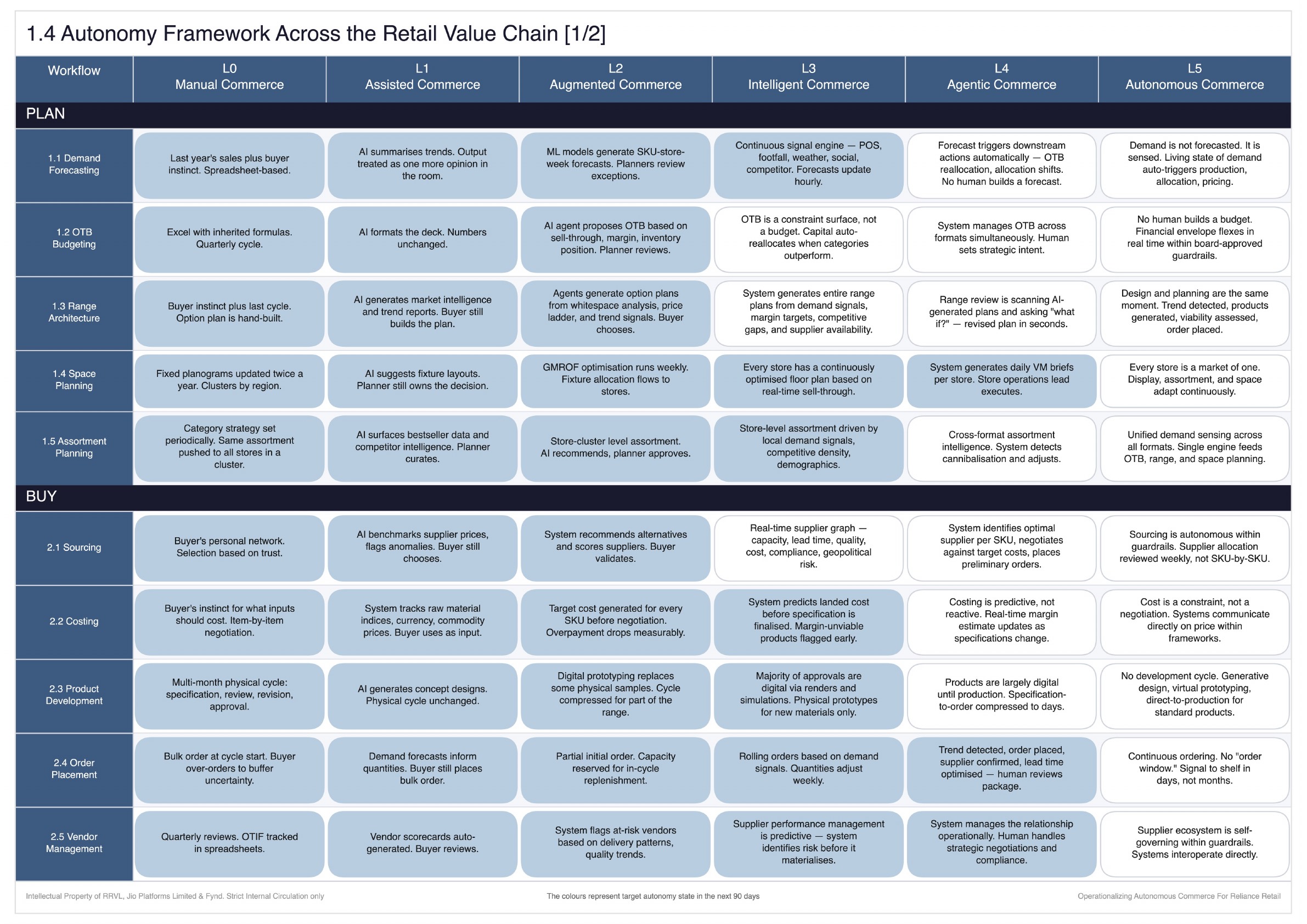
Verbatim from Operationalizing Autonomous Commerce for Retail · §1.4 · pp. 3-5. The paper extends the table to Asset (5.1-5.4), Finance (6.1-6.3) and HR (7.1-7.3) — not shown here as they sit outside the F&L Plan/Buy/Move/Sell value chain Impetus targets.
Three measurements decide whether a workflow is ready to move to its next level. Each one carries a rupee number. None of them is a feature count.
Per the four risk gates — how much inventory, procurement, supply chain, or revenue risk does the workflow now actively avoid? Quoted in rupees of capital at risk, not in tickets closed.
Decisions per hour at the new level vs the old. The L2 → L3 jump is a skill upgrade — same people, faster cycle, higher leverage. We measure that leverage directly.
What share of the system's decisions get reversed, escalated, or written off? L3 holds at low single digits within guardrails. L4 must beat that rate before the org accepts the identity shift.
The matrix is a workflow tool. Its deepest consequence is organisational. Once you set the target level per workflow, the org chart follows — because every role is defined by the workflows it touches. The move from L2 to L3 does not change the org chart. The planner is still a planner, the buyer is still a buyer — faster, better-informed, operating at higher leverage. The move from L3 to L4 changes what the organisation is. Planning teams compress from dozens to a handful of strategic minds who set intent and handle exceptions. Buying teams become acquisition strategists who manage supplier relationships and review AI-generated decisions. Supply chain teams become strategic operators who handle the disruptions that require human judgement.
Not everyone will step up. The honest reality is that L4 demands a capacity and ambition that not every person on every team possesses. The commitment is that the organisation will redirect, not displace — into work that did not exist before. The condition is equally clear: its people must become AI-native.